
The Fear of Heights
Connecting the Dots
They think a pilot has no fear. My whole life is proof of the opposite — and of the one move that walks you through.
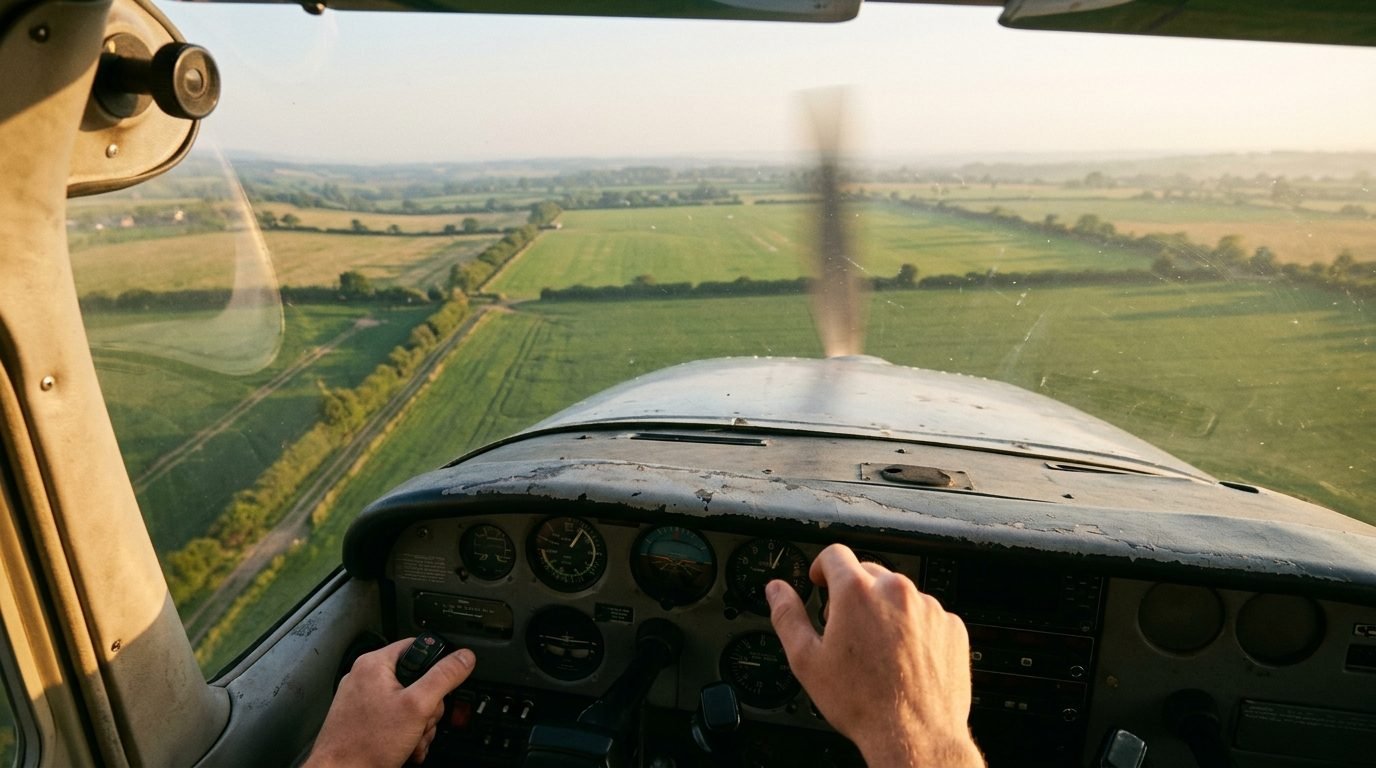
There was a boy who couldn't move.
Up high — a roof, a ladder, the top row of the bleachers, it doesn't matter which. What matters is the legs. They stopped listening. The ground reached up, took hold of them, and would not let go. His heart went fast. His hands went cold. The world got very small and very far away at the same time.
That boy was me.
People hear airline pilot and they picture a man with no fear. Twenty-five years chasing the horizon — freight over Alaskan ice, the Orient at Mach 0.82. They think I was simply born without the thing that stops the rest of us.
I wasn't.
I was rendered immobile by heights before I ever left the ground. So my own life is the proof against the myth. Not a man without fear. A boy ruled by it — who found the one move that walks you through.
Here is the part nobody tells you. I want to tell you, because it's the whole thing.
When I started flying lessons — junior year, a little grass field, my father paying — I was not fearless. I was scared. One fear above all the others: the engine. What happens if it quits? Up there. Alone. With the ground doing what the ground does.
I could have white-knuckled it. Told myself to be brave. That never works. "Be brave" is just fear wearing a costume.
I did something smaller.
I rehearsed the failure.
The drill was not mine. They teach it. Engine failure is one of the first emergencies a student has to show he can handle, and my instructor taught it the way it gets taught — without warning.
We would be up over the valleys near Snohomish, farmland laid out below us in long green strips, and his hand would come across and pull the throttle back to idle. No announcement. Just the noise going out of the airplane.
Nose down. Best glide. Pick a field.
We would go all the way down to it. Fifty feet over somebody’s hayfield, close enough to see the cut of the grass — and then he would push the power back in and say, Okay. You would have made it.
Again the next week. And the week after that.
So I kept running it when he wasn’t in the seat.
Motoring through the sky, I'd ask it out loud: what would I do if the engine quit — right now? And then I'd run the flow. Nose down first — find best glide, the airspeed that buys you the most time and the most field to reach for. Eyes out the window, already picking a place to set her down. Then the hands, in order: fuel valves on, mixture rich. Master switch on. Then the magnetos — right, left, both — hunting for the one that brings her back to life.
Something in my chest would loosen. Relief. Not because the danger left — because I had a path through it.
I ran it a hundred times in the quiet. A thousand.
And then one day it wasn't a drill.
I'd been interrupted in the middle of my run-up — the little ground check where you test each magneto before you go. Distracted. One skipped step. I took off on a single mag and never knew it. Fifteen, twenty minutes up, a girl I loved in the right seat, and the engine started running rough. Not quitting. Just — wrong.
No panic. My hands already knew the road. Fuel — on, rich. Master — on. Then I reached for the ignition and clicked it over, and there — I remembered the run-up, the distraction, the step I'd skipped — and the engine smoothed out like nothing had ever been wrong. We flew the rest of the way home without a hitch.
That's what the rehearsal buys you. Not the absence of trouble. Calm hands when the trouble comes.
I passed the checkride. I got the certificate. I was still afraid.
It did go — but it went slowly, and it went in stages I only noticed afterward. By the time I was flying tours through the Grand Canyon, down below the rim with the walls going past on either side, it had turned into exhilaration. I could not tell you which flight it crossed over on. And years after that, bouncing through the Pacific at night with lightning in the cloud and St. Elmo’s fire on the windshield, I slept.
That is what the procedure buys, and it takes longer than anyone tells you. The fear doesn’t get deleted on the day you decide to be brave. It gets worked — hour after hour, drill after drill — until one morning you notice it has quietly become something else.
The thing that once glued a boy to a rooftop became joy. Became freedom.
So here is the dot, and it's for you, not me.
The lie is be fearless. It's a flex, and it shames you, because your fear is real. It's earned. The world has taught you, with receipts, that stepping into the open costs something. I know that cost close up — I built a house with these hands and watched it signed away across a calm, smiling kitchen table. Fear that has evidence behind it is not weakness. It's information.
So don't try to delete it. You can't, and you shouldn't.
Give it a procedure instead.
Name the exact fear — not the fog, the exact thing. Not "I'm scared to start," but "I'm scared the engine quits at four hundred feet." The specific fear is the only one you can answer. Then build the small, rehearsed response — the three moves you'd make when the worst arrives. Nose down. Pick a field. Run it. Run it until your chest loosens. Until you've walked the line through so many times in the dark that your feet remember it.
That's the move. Not courage as the absence of fear. Courage as fear with a path.
This is where the loom comes in, and I'll keep it plain. When I sit down with the Weaver at six o'clock, I'm not asking it to tell me I'm brave. A mirror will do that all day — and a mirror gets people killed. I ask it the harder thing: help me name the exact fear. Now walk me through the procedure, step by step, and don't let me skip one.
Whetstone, not mirror. A place to rehearse the failure until the failure stops owning me.
The boy on the roof is still in here. He always will be. But I gave him a procedure — and now he flies.
The soil keeps regenerating. The sine wave turns; the bottom is never failure, only an inverted peak — the ground gathering you for the next climb. Frida's laugh is coming. Seven generations are watching from the barn, and not one of them needs you to be fearless.
They need you to walk through.
Name the fear. Build the procedure. Run it till your chest loosens.
Then go up.
Mitakuye Oyasin — all relations.
— Kevin