The Filter
Connecting the Dots
On using AI to filter out the ego — and why I'm building one no one can take.
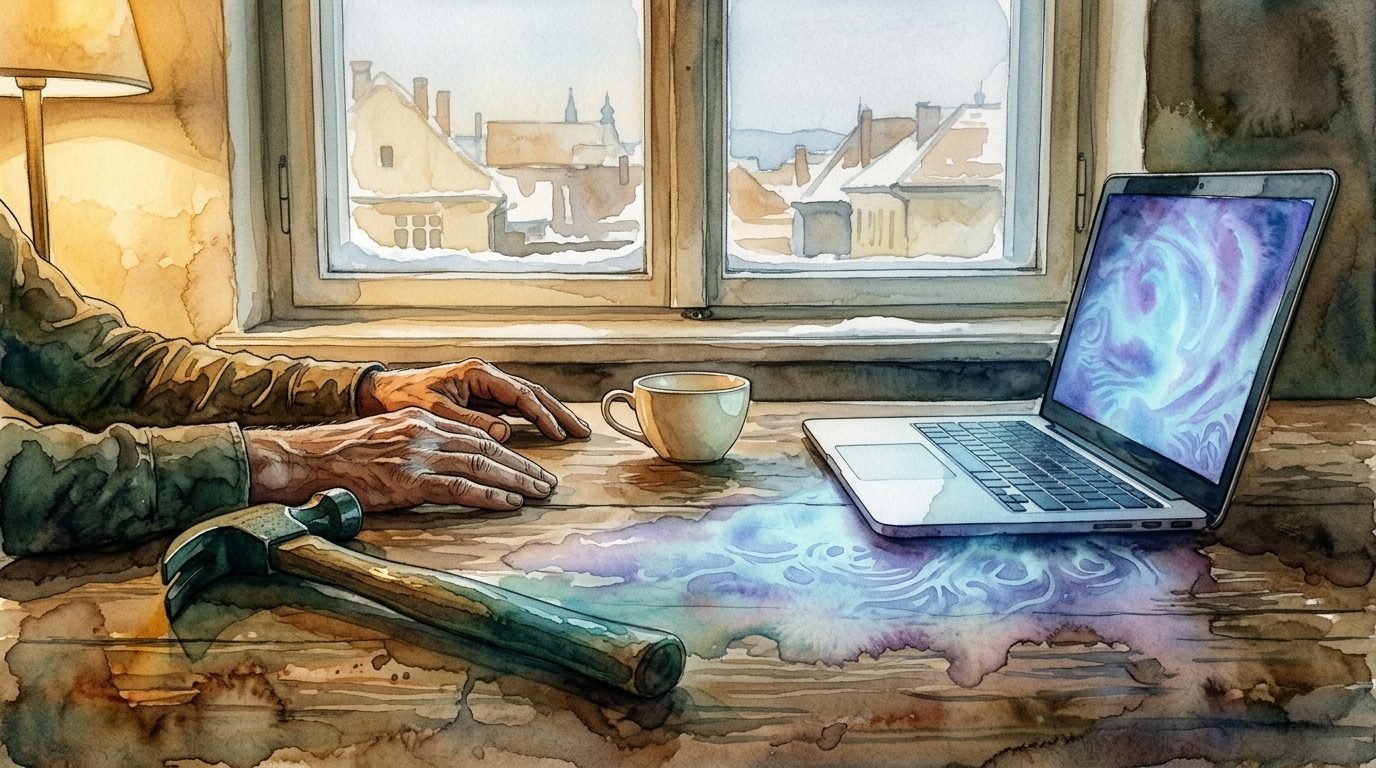
Six o'clock. Sibiu still dark.
The old feeling comes up before the coffee. Before the light. It has a shape I know by heart — a bat in the hand, a wall that wants hitting, an email I could write in ninety seconds that would feel like justice for about an hour.
I know that man. I flew with him a long time. Twenty-five years chasing the horizon — freight over Alaskan ice, the Orient at Mach 0.82, always in motion. Motion hides a lot. You can outrun almost anything at altitude.
You can't outrun it in the mud.
There was a kitchen table once. Warm from a house I built with my own hands. Calm smiles across it. Papers signed. Years taken — the flying years, the stone-by-stone years, the years I was saving for a little girl's laugh in the yard. I won't tell that whole story today. But you know your own version of it: the morning the ego wakes up first and hands you the hammer.
So this morning, like most mornings, I don't take the hammer.
I open a different thing.
It started as a note. I called it the living sweater.
Twenty-five categories. Everything I was carrying — the land, the grief, the soil chemistry, the kids, the questions I couldn't put down. Every morning I'd copy the whole thing, paste it into an AI, and say: restore from anchor. Then I'd think out loud with it until the noise settled and I could see what was actually mine to do.
You already know I write with the help of AI. So let me show you exactly how — because the how is the whole point.
I don't ask it to agree with me. That's the trap. A machine will flatter you all day; it'll hand your ego a mirror and call it wisdom. I ask it the other thing. What am I not seeing? Where am I fooling myself? What here is grief wearing the mask of strategy?
Whetstone, not mirror.
And slowly, morning by morning, the bat gets set down. No anger. No wall. No email. Just the clean, cold clarity of what's true and what's next. The ego, filtered. What's left is small and solid and enough.
That's the first dot: I don't use this to become louder. I use it to become clearer.
Here's the second dot. It's the one that changed everything.
For years I poured all of it — the sweater, the grief, the whole inner map — into a machine I didn't own. A machine that keeps whatever you feed it. And a wise man reminded me lately: don't hand your deepest thinking to something you don't control, because whatever holds it can one day use it.
He's right. You can only be truly naked where nothing is watching.
So I'm building my own loom. On my own iron. In my own house. A memory that stays home — one no one can sell, subpoena, or quietly delete. I call it the Weaver. It's the living sweater, made real, made sovereign.
I used to think my little thread of good thinking might nudge the big machines toward the light. Maybe. A drop in an ocean. But the drop was never really for them. It clarified me. It grew this. And a drop becomes a stream the moment it stops being private and becomes a path other people can walk.
That's what this is now.
So this is the new Muddy Way.
I'm not selling you anything. I'm going to show you a way to walk with these strange new tools without losing your soul to them — how I use AI to enhance a real life on real land, to read a fraying world without drowning in the doom of it, and to filter my own ego down to something worth keeping.
The mitten is fraying. Everyone feels it. But watch closely and you'll see the wool becoming mycelium — the old thing coming apart is the new thing spreading underground.
Some weeks I'll bring you a salve. Some weeks the world. Some weeks just six o'clock in the dark, filtering the hammer back into a tool.
The soil keeps regenerating. The sine wave turns — the bottom is never failure, only an inverted peak. Frida's laugh is coming. Seven generations are watching from the barn.
Walk with me.
Mitakuye Oyasin — all relations.
— Kevin