
Episode Three: The Mora Bell
The Muddy Way — The Lean Years
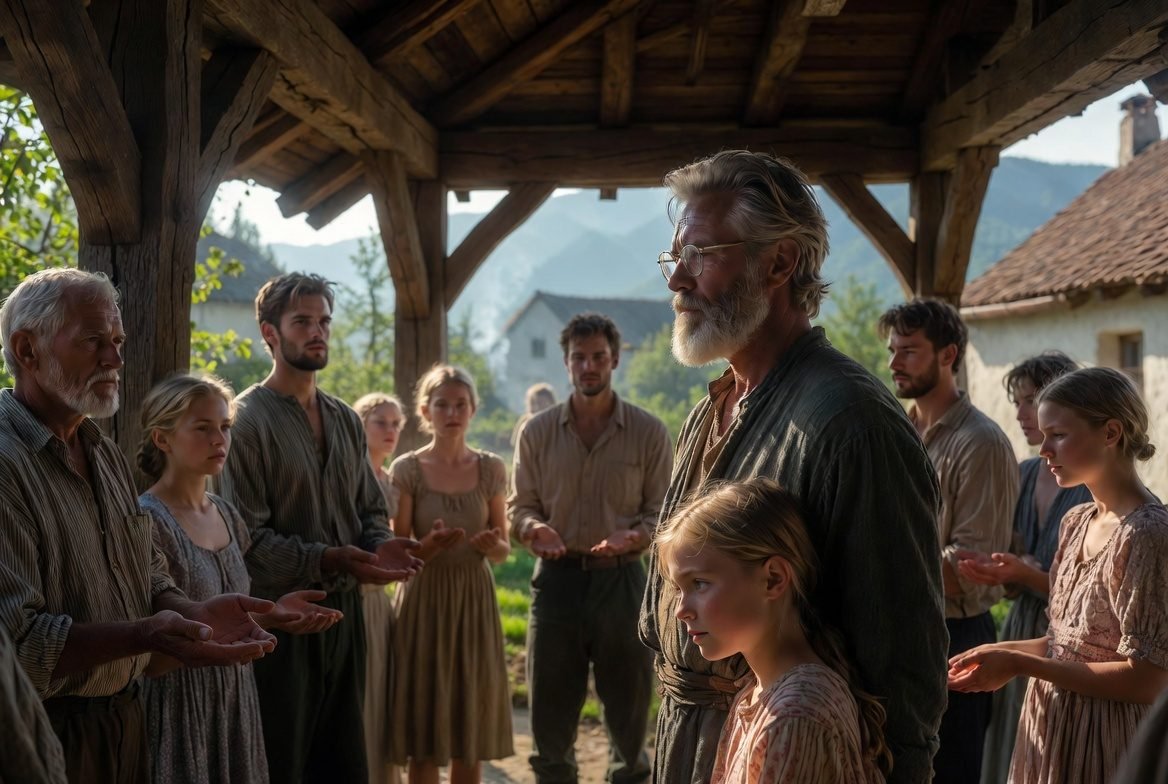
The blue sky above the rugged Carpathians stretched wide and clear. Twenty-five degrees by mid-morning, the air sweet with the breath of spring. Under the full-width oak-beam porch the family sat at the long wooden table, breakfast plates still warm from the fire. Wild-mint tea steamed in every mug. The garden beyond glowed — early crocus and wildflowers thick under the apple trees, tiny green fruit already forming like small promises. Wild bees moved slow and heavy between blossoms, their low hum mixing with the click of Corey’s knitting needles.
The living sweater rested across his lap, cream wool catching the golden light.
Axel finished the last of his rye bread and honey, wiping his hands on his trousers. “Radio said another power cut in Bucharest last night. Twelve hours. People sleeping in the streets because the apartments are too hot.”
Anthony leaned back, elbows on the table, the sun catching the faint grease still on his knuckles from the morning’s work in the barn. “Canada’s the same. Australia too. News trickles in slow now, but it’s all the same story — shelves empty, fuel gone, the big cities starting to fray at the edges.”
Corey nodded once, needles steady. The wool smelled of lanolin and the faint smoke from last night’s fire.
Iris sat cross-legged on the bench, bare feet swinging just above the cool stone. She licked honey from her thumb and looked up with the clear eyes of a seven-year-old who has already walked four springs in this garden. “The bees don’t fight over the flowers,” she said simply. “They just share. Why can’t the cities remember that?”
A soft laugh moved through the group. The porch felt alive — woodsmoke still clinging to the beams, the distant low of a cow, the faint sweetness of the swelling apples drifting down from the orchard.
Then the clear, bright ring of the Mora bell sounded from the front of the house — the old Swedish bell Corey had carried across Europe the first year he came to Șomartin. Its tone rolled across the stone walkway like a call to gather.
Old Mr. Müller arrived first, cap in hand, followed by three more families from the village. They came up the wide stone path that curved gently from the front gate, boots ringing softly on the smooth, hand-laid stones. Each carried a small bundle — a loaf of dark bread, a jar of last year’s plum jam, a handful of early wild greens.
Hans set his bundle on the table and sat with a grateful sigh. “The radio this morning said the last freight train from the port stopped two days ago. People in Sibiu are starting to look at each other sideways. But here…” He gestured toward the garden where the acclimated corn stood tall, the wheat already heading, the tomatoes heavy with small green fruit. “Here we have roots. You started saving those seeds four years ago, Corey. The crazy American with the knitting needles. At first we smiled. Now we see the foundation you built for yourself is holding us up too.”
A younger woman, Maria from the house by the stream, spoke next, voice tight but steady. “My husband lost his job at the lumber mill last week. No diesel for the trucks. He’s worried about winter. What if the wood runs low? What if we can’t heat the children?”
Anthony leaned forward. “We already stacked extra in the barn. And the rye wash we brewed last month — the wild yeast is strong. We can trade it for more wood if we need to. The village is the body now. Your children stay warm because mine will help cut the wood with you.”
Axel added, “The clover on the pathways keeps the soil alive. No compaction. The humus keeps rising, slow and steady, because we walk only where the clover grows thick.”
Hans looked out across the yard where the green clover paths wound between the beds like living veins. The black Transylvanian clay beneath them was waking up — richer every season, listening, remembering.
“The left-brain scramble is still loud on the radio,” Hans said. “Everyone for himself. Numbers and competition. But out here the right side of us is waking up — the part that feels the clay between the fingers, the warmth of the fire on the face, the low hum of gravity in the bones.”
Corey felt the words settle warm in his chest. He set the knitting aside. The living sweater lay warm across his lap. He stood, the sun on his face, the Carpathians blue behind the orchard.
“Today we do not solve the whole world,” he said. “Today we become one body. Everyone brought a little. We will share a modest feast — not because we have plenty, but because we choose to remember we belong to each other.”
They spread the bundles on the table. Dark bread, plum jam, wild greens, a small pot of fresh goat cheese from the house by the stream. It was not a banquet. It was enough.
They stood in a loose circle under the oak beams. Corey lifted his hands, palms open to the warm May sky. The others followed — Axel, Anthony, Iris, Hans, Maria, and all the rest who could come. Even those who could not be here today were held in the circle by the quiet knowing that the village breathes as one.
“Wopila,” Corey said softly. “In the Lakota way, this is thanksgiving from the heart every single day. Not just when the harvest is full. Not just when the sun is warm. Every day. When you practice it, the heart changes its shape. It brings a new perspective. And that gratitude roots deeper into the clay of the Transylvanian soil, the same way the clover roots keep the pathways loose and alive.”
Iris’s small voice joined in, clear and bright. “Thank you for the flowers. Thank you for the honey. Thank you that we are not alone.”
The circle breathed as one. The village — two hundred and fifty souls, including the ones who could not come that day — felt the old mitten fray a little more, but the bare hands underneath were warm, alive, remembering.
Row by row.
Stitch by stitch.
The living sweater grew longer, wide enough to hold them all.