
Episode Four: The Mycelium Spreads
The Muddy Way — The Lean Years
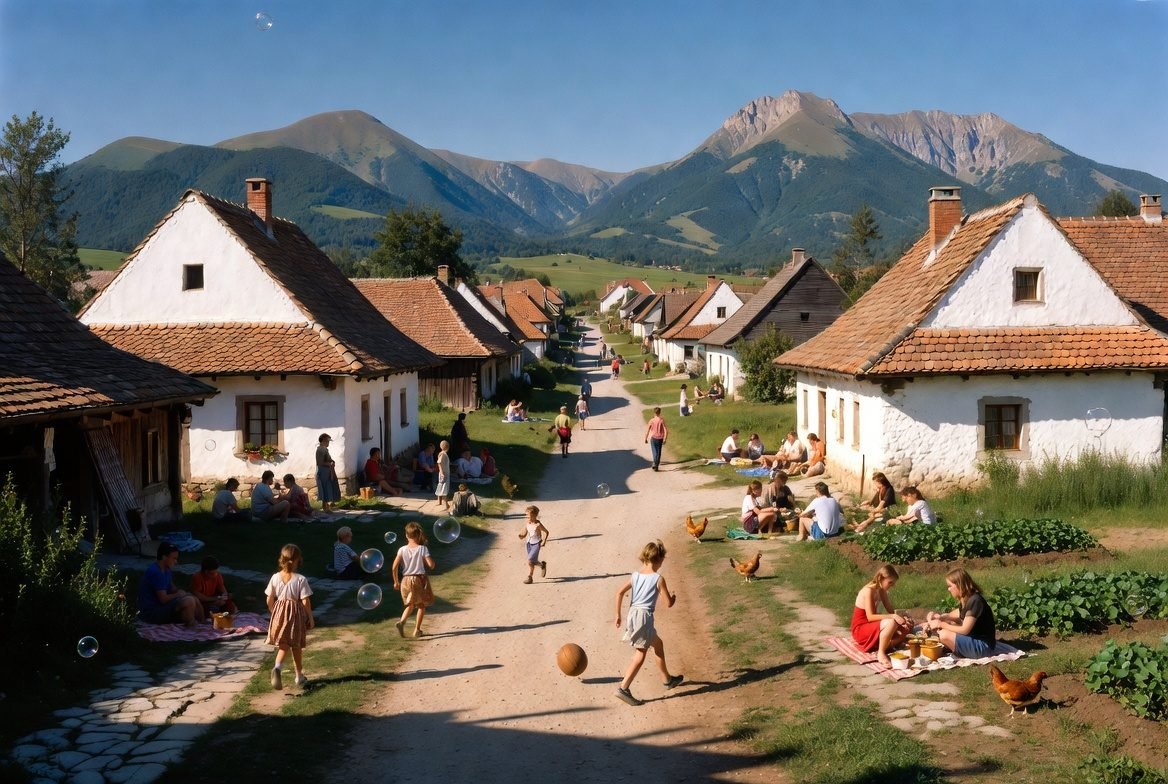
June had slipped in soft and warm, the air already brushing thirty degrees by mid-morning. The rugged, sharp Carpathians stood against a blue, cloudless sky, their ridges carrying the faint scent of pine and wild thyme all the way down to the village. Under the full-width oak-beam porch the family lingered at the long wooden table after breakfast, plates still warm from the fire. Wild-mint tea and fresh coffee steamed in the mugs. The garden beyond the clover pathways was alive — thick stands of wild edibles pushing up between the beds: dandelion greens, nettles, fat hen, the first sweet shoots of sorrel.
In the apple orchard the top-bar hives hummed with quiet industry. Corey had already taken one careful frame of honey the week before — golden, fragrant, just enough for the family and a few jars to trade. He left the rest for the bees. “We don’t take more and more,” he had told the children while they watched the frames drip. “The bees give us pollination for every tree and every bed. If we want more honey, we build more boxes. That is Earth Care.”
The living sweater lay across his lap, longer now by two hand-widths than it had been at the first frost. The needles moved without his looking at them.
Axel came up from the lower beds with radishes still trailing soil and set them in the middle of the table where everyone could reach. “First salads are in. The beds we broke our backs on all spring are paying us back.” He took one for himself. “And the wheat is standing. Our own bread this year, and enough over for the brewery.”
Anthony had come straight from the barn and did not sit down. He stood at the end of the table with a glass of the new beer, turning it against the light. “Third batch, and the wild yeast has finally settled. Barley enough for a small run of whiskey before the heat comes.” He drank. “We put two axles back under the Cincu wagons last week. They’re bringing them up today, loaded.”
Corey looked up from the wool at that. Loaded. Coming to us. Four years ago he had driven that same road with a trailer of firewood behind him and put the Dacia in to its rims, and a boy with a stick had stood in the mud and laughed at him.
Iris came out of the orchard with her hands cupped, walking the way you walk when you are carrying something alive. She opened them just enough for her father to see — a bee, moving slow across her palm, in no hurry at all. “She’s not stinging,” Iris said. “She’s just resting.” She carried it back to the hive and set it down at the entrance, and stayed a moment watching the traffic in and out before she came back to the table.
Then the Mora bell rang from the front of the house. The same bell, the same short bright note Corey had carried across Europe in a crate of books — but nobody looked up this time, because everyone already knew what it meant, and half the village was on the path.
The villagers began to arrive, walking up the wide stone path that curved gently from the front gate. Boots rang softly on the smooth, hand-laid stones. They came in small family groups from Șomartin, Bruiu, and three wagons from Cincu twenty kilometers away, each wagon creaking under bundles of traded goods. People wore a gentle mix — traditional embroidered vests and headscarves alongside simple modern shirts and trousers, all clean and cared for.
The gathering did not stay under the porch. It spilled out into the streets of Șomartin — the wide, unpaved lanes between the white-plastered houses with their red clay tile roofs. Children ran and laughed, blowing soap bubbles that floated like tiny rainbows in the warm June air. A leather ball bounced between bare feet. Older boys kicked it back and forth while little girls chased the bubbles, their voices bright as the wildflowers under the apple trees.
The women gathered in a loose knot near the stone wall, baskets on their hips, voices low and steady. Maria from the house by the stream spoke first, her tone tight but grateful. “My sister in Cluj called yesterday. The markets are half-empty and the queues are long. She’s worried about winter. But here… we already have the wild greens and the early carrots coming. I’m thankful we listened when you started sharing the seeds, Corey. We’re becoming something solid.”
The men gathered a few paces away, small glasses of Anthony’s wild-yeast beer and the strong, clear pălinca from Cincu in their hands. Hans raised his glass toward the garden. “I finished a small carpentry project yesterday — new shelves for the root cellar. Fixed the old wheelbarrow wheel that was wobbling for months. And my garden is growing by leaps and bounds this year. The soil feels different, richer. Out there the world is still playing the old game — everyone for himself. Here we’re learning a new one.”
Families with children sat on blankets spread across the grass, watching the little ones play. A young mother rocked her baby while her husband kept an eye on the ball game. “The cities sound like they’re coming apart,” she murmured. “Bucharest is overrun now — people pouring in from the south looking for food and work. The big population centers are swelling and fraying. But the smaller villages, especially places like ours off the beaten track, have almost no strangers coming in. It feels… steady.”
Corey stood at the edge of the gathering, the living sweater draped over one shoulder, needles still in his hand. The warm sun pressed against his skin, the distant hum of the bees a steady heartbeat behind every word.
“The cooperation we started years ago is growing,” he said, voice calm and carrying. “Not only between these three villages. The tentacles are spreading like mycelium under the soil — small groups are already talking as far as Sighișoara and Mediaș. That is People Care. We look after one another the same way we look after the land. We share tools, share seeds, share knowledge. We make sure every family has what it needs to stand strong. Today we see it living in the streets — children playing, neighbors trading, the whole village becoming one body.”
Iris ran up, cheeks flushed, a soap bubble still clinging to her hair. “Papa, the bubbles don’t fight the wind. They just float and share the sky.”
The modest feast spread across blankets on the grass and the stone walkway — fresh loaves of dark rye, jars of last year’s plum jam, bundles of wild greens and early radishes from the Cincu wagons, a small wheel of goat cheese wrapped in cloth, and a few precious pots of the first honey saved from the top-bar hives. It was not abundance. It was enough.
They stood in a loose circle under the oak beams. Corey lifted his hands, palms open to the warm June sky. The others followed — Axel, Anthony, Iris, Hans, Maria, and all the rest who could come. Even those who could not be here today were held in the circle by the quiet knowing that the village breathes as one.
“Wopila,” Corey said softly. “In the Lakota way this is thanksgiving that lives in the heart every single day. Not just when the harvest is full. Not just when the sun is warm. Every day. When you practice it, the heart changes its shape. It brings a new perspective. And that gratitude roots deeper into the clay of the Transylvanian soil, the same way the clover roots keep the pathways loose and alive.”
Iris’s small voice joined in, clear and bright. “Thank you for the flowers. Thank you for the honey. Thank you that we are not alone.”
The circle breathed as one. The growing community — two hundred and fifty souls, including the ones who could not come that day — felt the old mitten fray a little more, but the bare hands underneath were warm, alive, remembering.
Row by row. Stitch by stitch. The living sweater grew longer, wide enough to hold them all.